Legacy Robot Restoration & Inspection Tooling
Restored two unsupported industrial arms, rebuilt the ROS workstation, and developed synthetic-data and YOLO tooling for an inspection research direction — without publishing an invalid detector metric.
- Recover unsupported research hardware and create an inspection-development environment when the original software and controller stack no longer worked reliably.
- Hardware restoration + robotics workstation + perception prototype
- Restoring the platform made later robotics experiments possible and exposed the difference between a detector demo and a valid held-out evaluation.
Who did what
- Solo research assistant under Dr. Kevin Wedeward — restoration, ROS environment, synthetic data, and inspection experiments
- Dr. Kevin Wedeward, Fort Lewis College
- Individual undergraduate research with faculty supervision.
- Sawyer and Baxter vendor stacks, ROS Noetic, MoveIt, Gazebo, Blender, and YOLO.
Overview
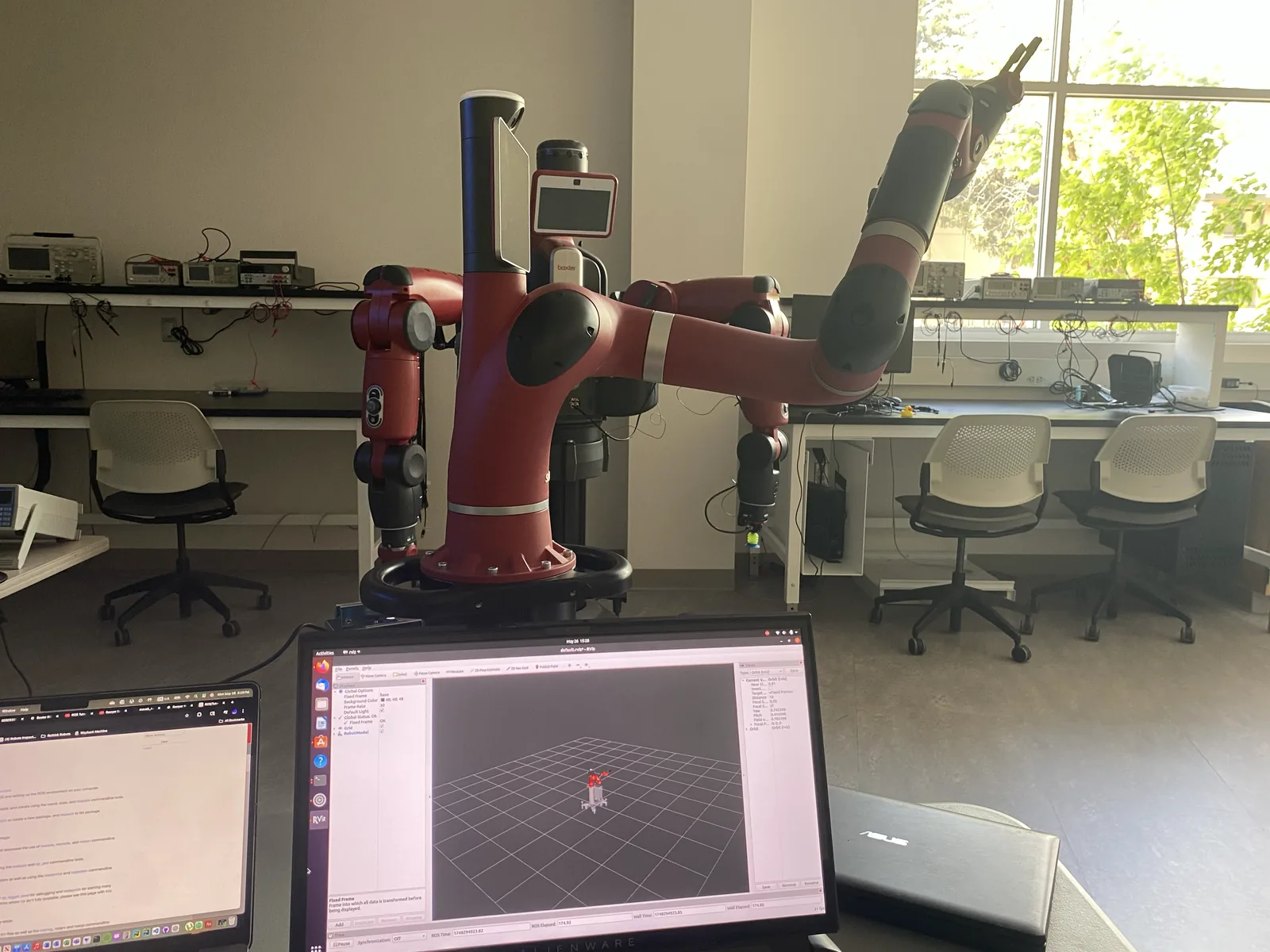
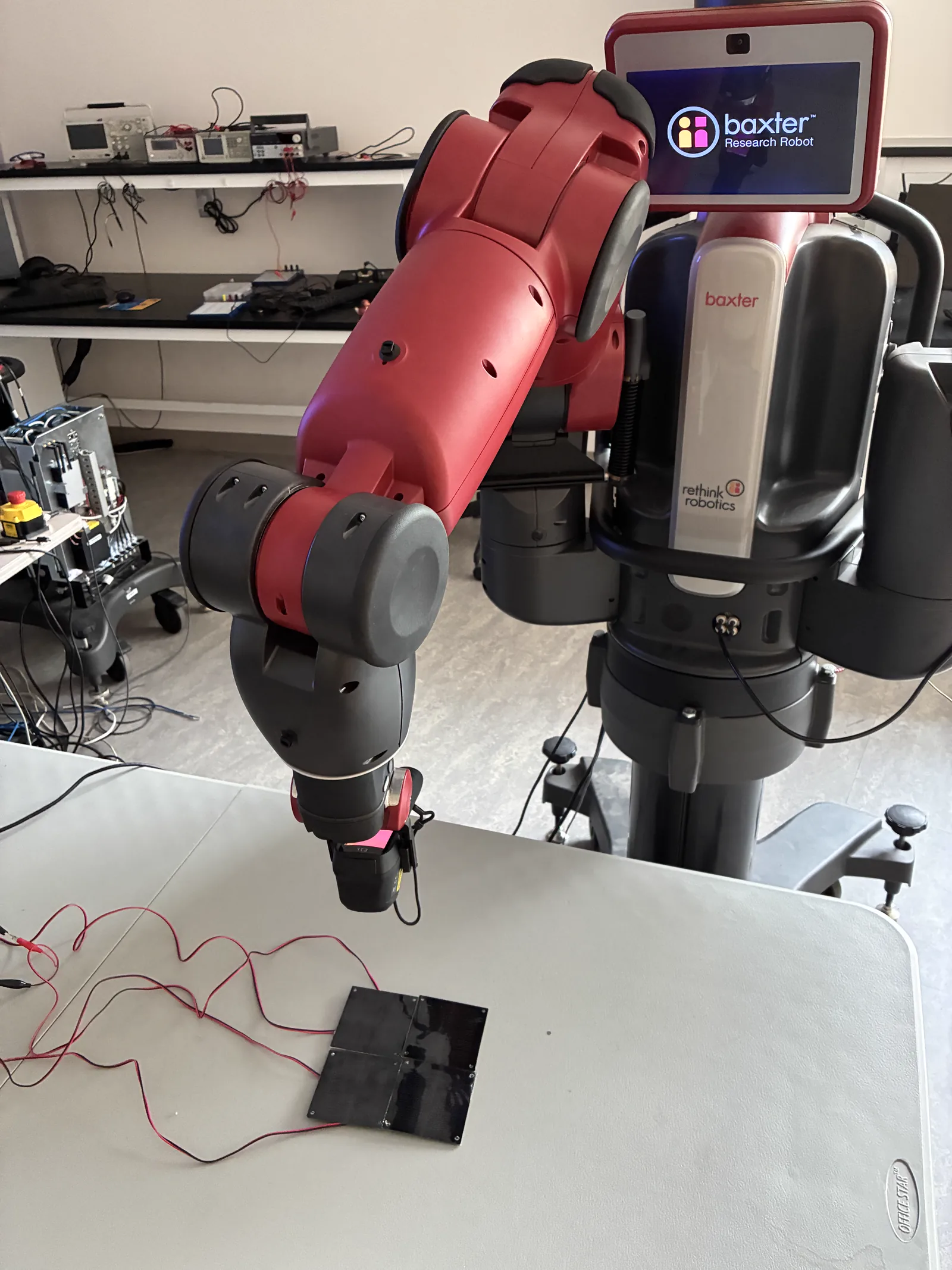
The project began with two nonfunctional legacy robots and limited vendor support. I diagnosed controller and boot problems, restored operating environments, and rebuilt a ROS Noetic / MoveIt / Gazebo workstation so the arms could again be simulated and programmed. In parallel, I developed Blender/Python synthetic-data tooling and YOLO-based inspection experiments. Earlier résumé and portfolio versions reported a 0.985 mAP on 1,682 thermal images; the evidence audit found that the public training configuration reused training images for validation and did not preserve the claimed thermal dataset or a valid held-out results file. Those numbers are therefore removed. What remains is still useful: robot restoration, systems troubleshooting, synthetic-data generation, inspection tooling, and a symposium-award research direction.
Methodology
- Recovered controller and workstation functionality through hardware inspection, operating-system repair, firmware and BIOS configuration, networking, and ROS environment reconstruction.
- Built qualitative synthetic-data and detection tooling in Blender, Python, and YOLO while auditing the boundary between a demo and a held-out evaluation.
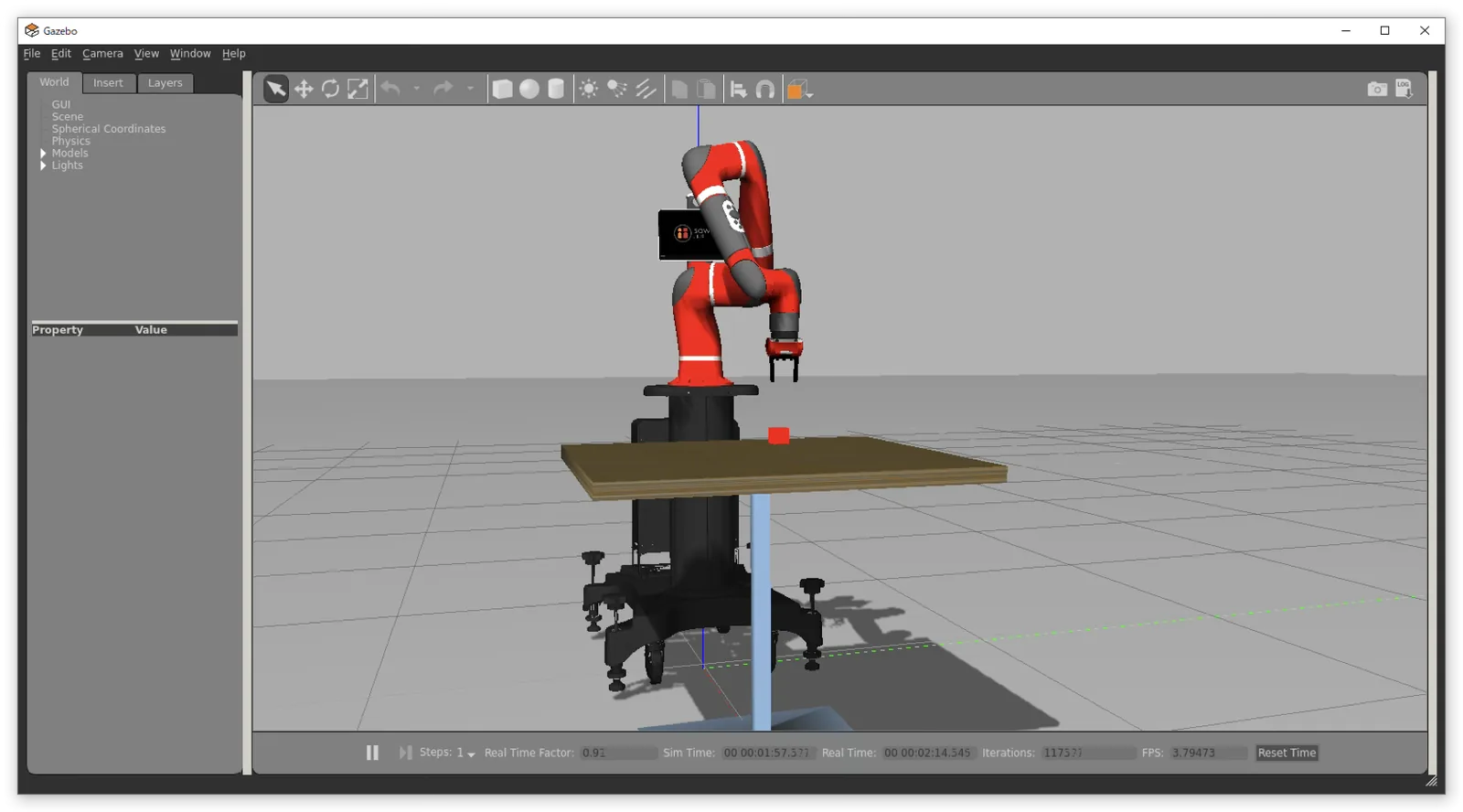
The supported work has three layers: recover the robot controllers, rebuild the ROS planning environment, and develop synthetic-data/detection tooling. A valid held-out detector evaluation remains future work rather than a retroactive claim.
- Legacy robot diagnostics
- Recovered controller + OS
- ROS / MoveIt / Gazebo workstation
- Synthetic image + label generation
- YOLO experimentation with held-out evaluation still required
My contribution
- Diagnosed hardware and boot failures through controller inspection, storage/OS recovery, BIOS and firmware configuration, and network troubleshooting.
- Rebuilt a ROS Noetic workstation with MoveIt and Gazebo for motion-planning and simulation workflows.
- Created Blender/Python synthetic inspection scenes, automatic labels, YOLO training tooling, and demonstration assets.
- Documented Baxter troubleshooting so future students could reproduce common startup and ROS-network fixes.
- Presented the inspection research direction at the Fort Lewis College Physics & Engineering Symposium, receiving second place.
Provenance & claim boundary
- Vendor ROS packages and workspaces are upstream; the contribution is restoration, environment integration, custom scripts, synthetic-data tooling, and documentation.
- No mAP, accuracy, thermal-image count, live thermal feed, or closed-loop hardware-inspection result is claimed because the audited repositories do not support those statements.
Experimental design
- Preserved restoration records, ROS workspaces, troubleshooting notes, generated scenes, labels, and qualitative inspection examples.
- Rejected the former detector result because the available configuration reused training images for validation and did not preserve the claimed dataset or valid held-out result file.
Results & evidence
Evidence
Restoration record
attachedController photographs, boot/SDK errors, repair notes, ROS workspaces, and troubleshooting guide.
Synthetic-data tooling
attachedBlender assets, generation scripts, automatic labels, and inspection examples.
Research recognition
attachedSecond place at the September 2025 Physics & Engineering Symposium.
Metric boundary
attachedPrevious 0.985 mAP / 1,682-image claim removed after the evidence audit found no valid held-out artifact.
Metrics
2
2nd place
None
Prototype
Failure analysis
- Unsupported software, controller state, networking, and operating-system compatibility were the initial blockers before perception experiments could begin.
- Train-as-validation output exposed a methodological failure: an attractive metric without independent held-out evidence does not demonstrate generalization.
Limitations
- The public vision repositories do not preserve a valid train/validation/test split or the previously stated detector results.
- Simulation, synthetic inspection examples, and restored hardware do not establish a closed-loop autonomous inspection system.
- The Baxter troubleshooting repository is a practical reference, not sole proof of every repair event.
Lessons & tradeoffs
- Restoration work can be the highest-leverage research contribution when the platform is otherwise unusable.
- Train-as-validation output can make a model look excellent while providing no evidence of generalization.
- Removing an unsupported metric makes the remaining systems work more credible.
Next questions
- Can a versioned dataset with subject-independent train, validation, and test splits support a defensible inspection baseline?
- What sensing and synchronization are required for closed-loop inspection on the restored physical arms?