Humanoid Navigation Research on the Booster K1
A completed 1,077-episode simulation benchmark, an audited K1 locomotion stack, and a controlled study of how embodiment and viewpoint shape navigation failure.
- How does a shorter humanoid embodiment change the visual evidence, locomotion demands, and stopping behavior of a navigation policy evaluated on the same task distribution?
- Simulation benchmark + locomotion/deployment engineering + active controlled study
- A policy cannot be called embodiment-robust when camera geometry and controller interfaces change the problem it actually sees.
Who did what
- Research assistant — K1 embodiment integration, evaluation harness, locomotion diagnostics, evidence ledger, and experiment design
- Dr. Yiyan Li, Fort Lewis College
- Independent undergraduate research with faculty supervision.
- NaVILA, VLN-CE-Isaac, Isaac Lab, RSL-RL, and Booster Robotics training and deployment frameworks.
Overview
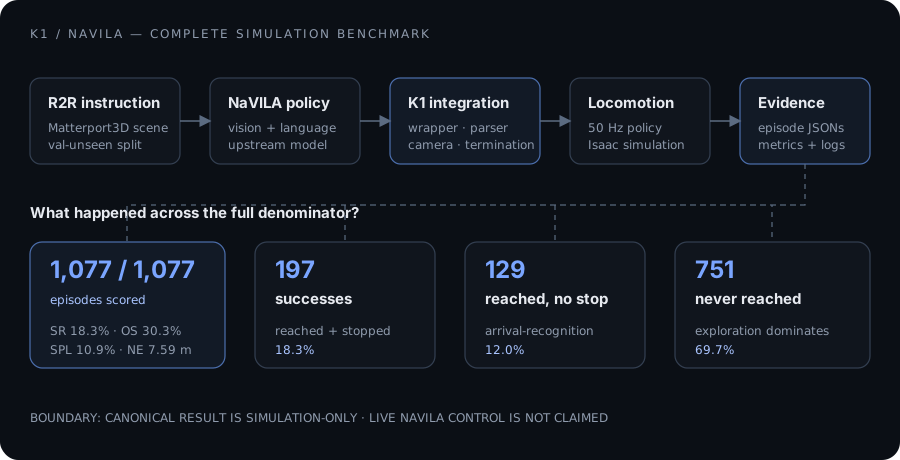
This project adds the Booster K1 as a new embodiment in the VLN-CE-Isaac / NaVILA evaluation stack. The canonical run completed all 1,077 R2R val-unseen episodes in Isaac Sim: 197 successes (18.3% SR), 326 episodes that reached the goal radius at some point (30.3% oracle success), 10.9% SPL, and 7.59 m final navigation error. The most useful result was the decomposition. Of the 326 reaches, 129 failed to stop, while 751 never reached the goal region. That distinguishes arrival recognition from the larger exploration cost created by the K1's lower viewpoint. The active follow-up is a pre-specified camera-height and image-transform sweep; it remains in progress and is not presented as a finished paper result.
Methodology
- Added K1-specific robot, camera, observation, action-parser, and evaluation interfaces to the existing NaVILA / VLN-CE-Isaac stack, while preserving upstream ownership.
- Ran the navigation policy through a K1 wrapper and 50 Hz locomotion policy, preserving per-episode measurement artifacts instead of relying on a summary screenshot.
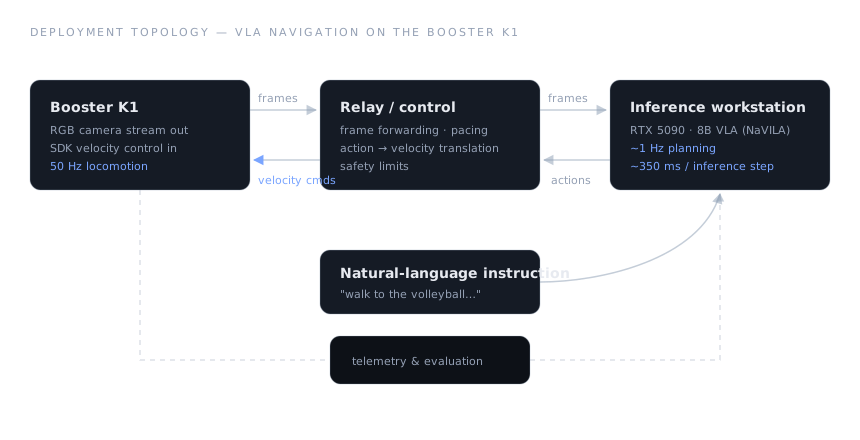
- Audited locomotion and deployment contracts separately from the canonical navigation evaluation so simulation performance, physical locomotion, and live closed-loop deployment remain distinct claims.
Natural-language navigation decisions are evaluated through a K1-specific benchmark wrapper and a 50 Hz locomotion policy. The wrapper aligns observations, joint ordering, commands, camera geometry, and termination logic; the evaluation layer preserves per-episode trajectories and metrics for failure analysis.
- R2R instruction + Matterport3D scene
- NaVILA vision-language policy
- K1 wrapper + action parser
- 50 Hz locomotion policy
- Episode measurements + failure decomposition
My contribution
- Integrated K1 robot, camera, observation, wrapper, parser, and evaluation surfaces into the upstream NaVILA benchmark instead of treating the inherited stack as authored work.
- Completed and preserved the 1,077-episode canonical evaluation with per-episode measurement JSONs and a regenerable metric script.
- Separated never-reached, reached-without-stopping, and successful episodes to turn one aggregate score into testable failure mechanisms.
- Extended Booster training and deployment frameworks with K1-specific environment configuration, reward terms, observation-contract checks, validators, filtering, and safety-aware mode handling.
- Maintained an evidence ledger that records supported claims, nuanced values, conflicts, and missing raw artifacts rather than silently choosing the most favorable number.
Provenance & claim boundary
- NaVILA, VLN-CE-Isaac, Isaac Lab, RSL-RL, and Booster training/deployment code are upstream foundations; the contribution is the K1-specific integration, experiments, diagnostics, and analysis.
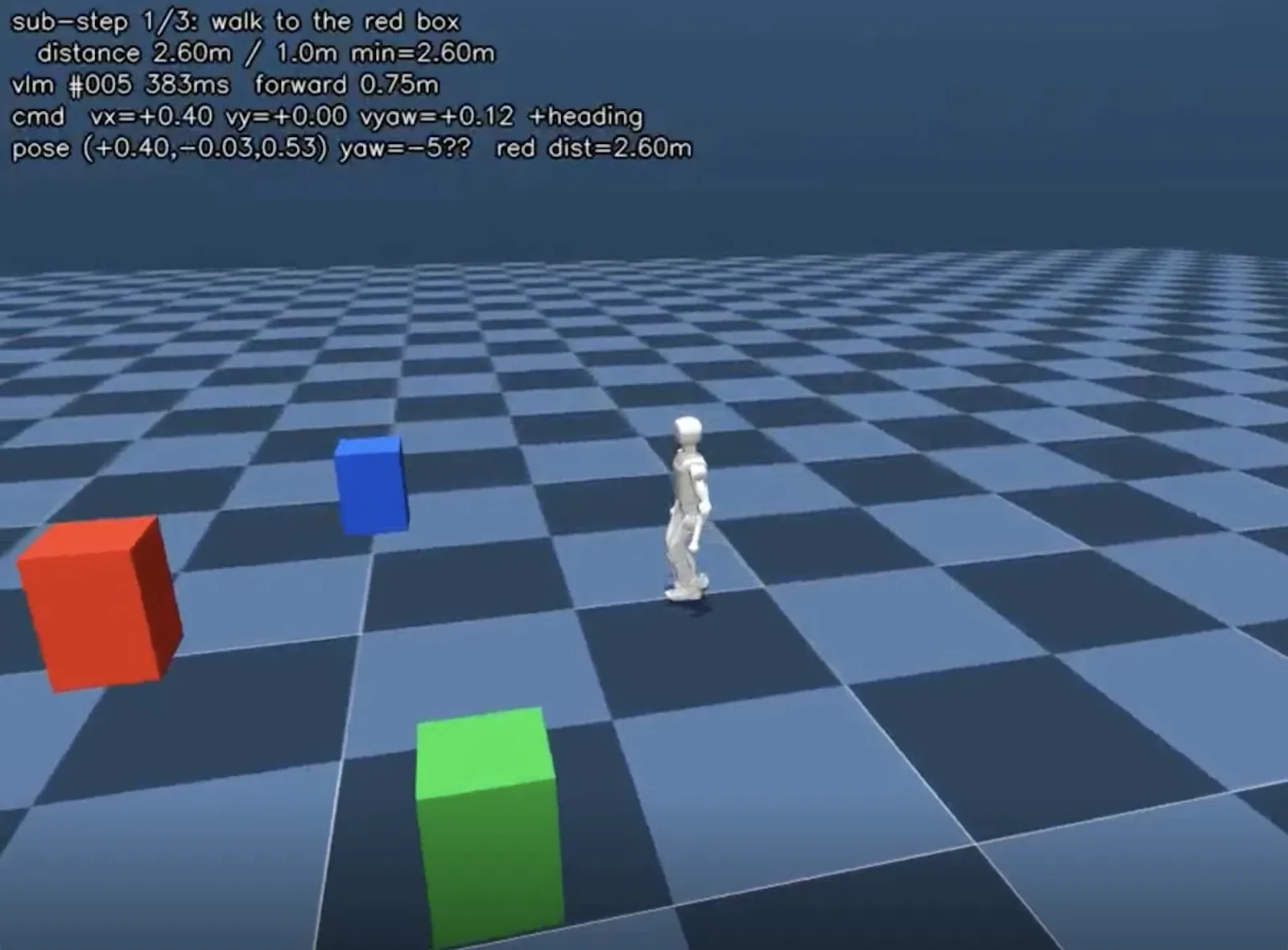
- The canonical 18.3% result is simulation-only. The public K1 volleyball clip shows physical locomotion but has no synchronized model trace, so it is not evidence of live NaVILA control.
- The recorded below-1% prior baseline is useful context but its original raw run directory was unavailable during the evidence audit; the final 1,077-episode result is fully preserved and regenerable.
Experimental design
- Scored the complete 1,077-episode R2R val-unseen set under one canonical simulation configuration and reported SR, oracle success, SPL, and final navigation error.
- Partitioned every episode into never reached, reached without stopping, or successful to separate exploration and arrival-recognition behavior.
- Pre-specified a follow-up camera-height and image-transform sweep after nondeterministic repeat runs invalidated the original paired-retry design; the sweep remains active.
Results & evidence
Evidence
Canonical result
attached1,077/1,077 episodes scored; 197 successes; all measurement artifacts preserved.
Failure decomposition
attached751 never reached, 129 reached without stopping, and 197 succeeded.
Evidence ledger
attachedClaim-by-claim receipts, conflicts, regeneration commands, and provenance boundaries are public.
Current experiment
attachedViewpoint and image-transform sweep is labeled active; interim completion does not substitute for a final result.
Metrics
1,077 / 1,077
18.3%
30.3%
10.9% / 7.59 m
Failure analysis
- 751 episodes never entered the goal radius, making exploration and observation shift the dominant observed failure class.
- 129 episodes reached the goal radius but did not stop, isolating a smaller arrival-recognition or termination problem.
- The decomposition identifies mechanisms but does not prove that camera height caused them; that causal question belongs to the active controlled sweep.
Limitations
- The canonical result is simulation-only and does not establish live NaVILA navigation on the physical K1.
- The current viewpoint sweep is active and its design changed after nondeterministic repeat runs invalidated the original paired-retry assumption.
- Aggregate navigation scores alone cannot isolate perception, exploration, locomotion, parser, and stopping failures; the decomposition narrows but does not eliminate that ambiguity.
Lessons & tradeoffs
- A new embodiment changes the observation distribution before any learning algorithm changes.
- Reaching and recognizing arrival are different capabilities and should not be collapsed into one failure label.
- An evidence ledger is part of the research system: it prevents stale slides and attractive demos from outrunning the data.
Next questions
- How much of the K1 performance gap is explained by viewpoint alone when policy, task set, and evaluation logic are held fixed?
- Can observation transforms or viewpoint-aware training improve exploration without degrading stop behavior?
- What instrumentation is required before a physical K1 run can support a defensible closed-loop NaVILA claim?